
-
Buy Now
€89,00
Aircraft Fuel Tank Safety Phase 1 & 2 - Initial
Ref: Appendix IV to AMC5 145.A.30(e)
-
-
Welcome
FREE PREVIEW -
Understanding of the background and the concept of fuel tank safety
-
The theoretical background behind the risk of fuel tank safety
-
The major accidents related to fuel tank systems, the accident investigations and their conclusions
-
SFAR 88 of the FAA and JAA Interim Policy INT POL 25/12
-
Modifications, airworthiness limitations items and CDCCL
-
Where relevant information can be found and how to use and interpret this information in the applicable maintenance data as defined in 145.A.45(b)
-
Fuel Tank Safety during maintenance
-
Flammability reduction systems when installed
-
Recording maintenance actions, recording measures and results of inspections
-

Fuel Tank Safety Phase 1 & 2 Training - Initial
- €89,00
- 21 lessons
- Presentation with Audio
- EASA Compliant
- Instant Certification
One-off payment, instant access, certificate emailed the day you finish
About the Instructor

KIVANC NEROGLU
Kivanc Neroglu is a Senior Aviation Professional with 15 years of experience in training, quality, compliance monitoring, and safety in aviation.
Within these 15 years, Kivanc took various nominated manager roles at Continuing Airworthiness Management, Maintenance and Maintenance Training Organisations globally.
He holds a Bachelor's degree in Aerospace Engineering from METU, and numerous certifications in aviation maintenance and quality management.
Email
Your certificate
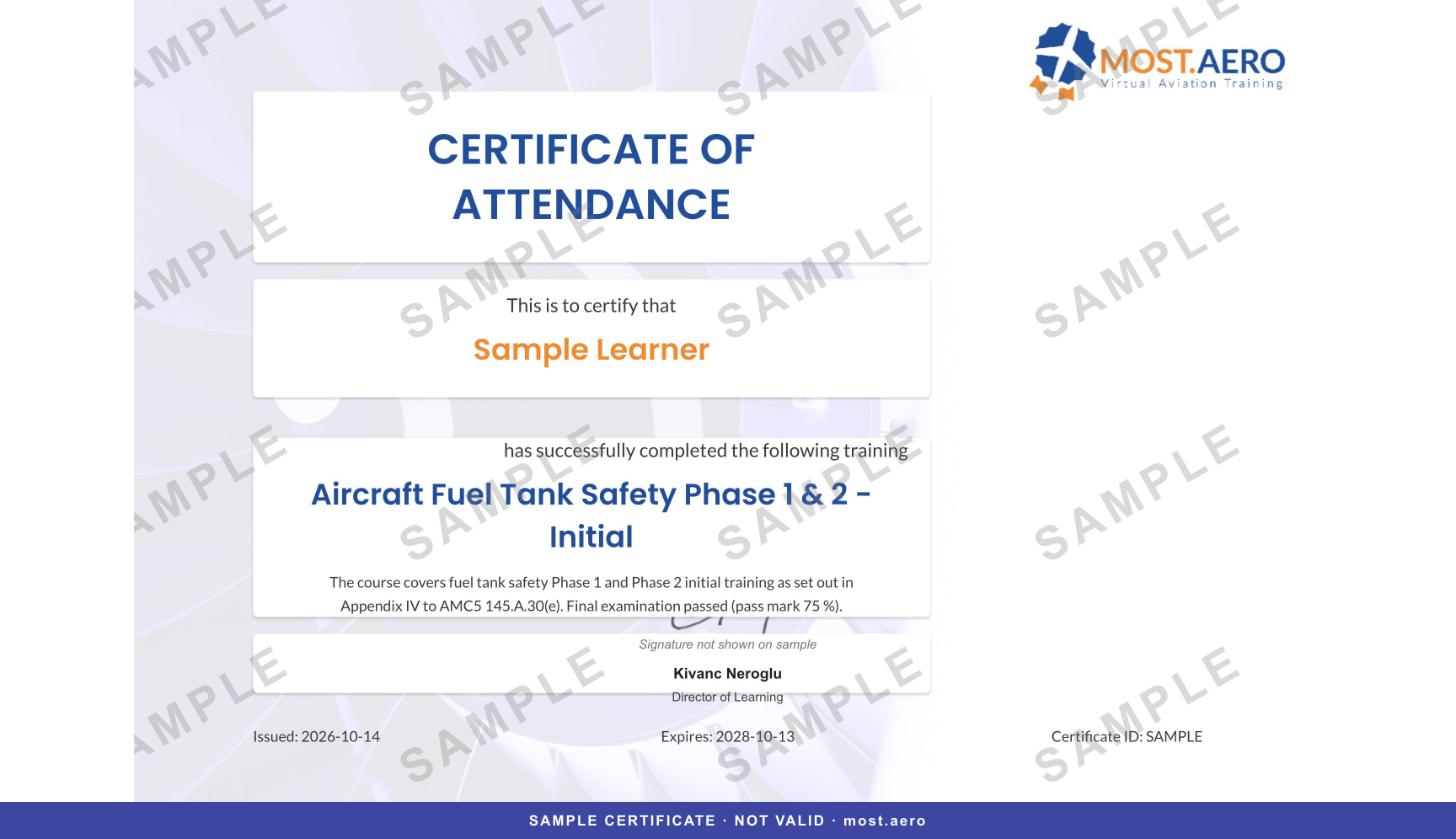
A watermarked sample of the certificate for this course. Your own certificate carries your name, the course, the issue date, an expiry date two years later and a unique certificate ID, and is emailed the day you finish.
Compliance Details
This course is tailored for aviation professionals involved in Continuing Airworthiness Management Organisations (CAMO) and Maintenance and Repair Organizations (MROs).
-
Compliant with Appendix IV to AMC5 145.A.30(e) and AMC2 145.B.200(a)(3) (ED Decision 2022/011/R) — fuel tank safety Phase 1 & 2 initial training
-
Also referenced for CAMO staff via Appendix XII to AMC M.A.706(f)
-
Covers the general objective and all eight syllabus items (i)–(viii), from the theory of fuel tank safety to recording maintenance actions
-
Nine chapter quizzes and a 30-question final examination — each must be passed to proceed
About Fuel Tank Safety Training — Phase 1 & 2 Initial
EASA’s rules for maintenance organisations require fuel tank safety training for the staff who plan, perform, supervise, inspect or certify maintenance on the affected large transport aeroplanes. The syllabus is set out in Appendix IV to AMC5 145.A.30(e) and AMC2 145.B.200(a)(3) (ED Decision 2022/011/R), and the same training is referenced for continuing airworthiness staff via Appendix XII to AMC M.A.706(f). This course delivers the Phase 1 and Phase 2 initial training in a single programme.
The nine chapters carry the syllabus items verbatim as their titles — the lesson list above mirrors it topic for topic: the background and concept of fuel tank safety, the theoretical background behind the risk, the major accidents and their investigations, SFAR 88 of the FAA and JAA Interim Policy INT POL 25/12, modifications, airworthiness limitation items and CDCCL, where the relevant information is found in the applicable maintenance data and how to use it, fuel tank safety during maintenance, flammability reduction systems, and recording maintenance actions. A dedicated film lesson covers TWA 800 and fuel tank safety. Each chapter ends with a quiz, and the course closes with a 30-question final examination; every quiz and the final must be passed to complete the course.
Who typically takes this course:
- Certifying staff, inspectors, mechanics and technicians in Part-145 organisations
- Maintenance planners, supervisors and fuel system component workshop staff
- CAMO continuing airworthiness staff, plus management, compliance and safety staff
The course is delivered as presentation slides with voice-over across 21 lessons, with instant access after purchase and a same-day digital certificate on completion.
Recommended Courses
-

Aircraft Fuel Tank Safety Phase 2 - Continuation
CourseIn accordance with EASA Part-145 (Appendix IV to AMC5 145.A.30(e) and AMC2 145.B.200(a)(3)) and Part-M (Appendix XII to AMC M.A.706(f) and AMC1 M.B.102(c)), and it fulfills EASA continuation training requirements for compliance.
€49
-

EWIS Target Group 1 & 2 - Continuation
CourseThis course has been prepared to meet the continuation training requirements.
€49

Frequently Asked Questions
-
Who is most.aero?
most.aero is a virtual aviation training platform developed by Aeroviser offering premium virtual aviation training courses complying with applicable requirements and regulations for online completion.
-
Are your certificates valid worldwide?
All our courses are developed by qualified aviation professionals and compliant with applicable syllabus requirements. We have numerous clients worldwide, all of whom accept our certificates. However, it is up to the organization whether to accept training certificates. All syllabus is available within each course description. There is no EASA prescribed organisation approval to deliver such training courses. Those courses are all outside of the scope of EASA 147 Aproval.
-
How do your courses look like?
All courses on this platform are developed by qualified and experienced aviation professionals by following the requirements defined in aviation legislations. All courses contain premium quality presentation slides with voice over.
-
Who needs fuel tank safety training?
Personnel of Part-145 maintenance organisations and CAMOs who work with the affected large transport aeroplanes: everyone who plans, performs, supervises, inspects or certifies maintenance on these aeroplanes and on their fuel system components when the maintenance data are affected by CDCCL — certifying staff and inspectors, mechanics and technicians, planners and supervisors, component workshop staff, CAMO continuing airworthiness staff, and the management, compliance and safety staff who monitor this work.
-
Which regulation does this course follow?
The chapter titles follow, verbatim, the items of Appendix IV to AMC5 145.A.30(e) and AMC2 145.B.200(a)(3) (ED Decision 2022/011/R), covering Phase 1 and Phase 2 initial fuel tank safety training. The same training is referenced for CAMO staff via Appendix XII to AMC M.A.706(f).
-
Does the course include an exam?
Yes. Each of the nine chapters ends with a quiz, and the course closes with a 30-question final examination. Every quiz and the final examination must be passed to proceed and complete the course.
-
What do I receive when I complete the course?
A digital certificate is emailed the same day you complete the course. Your certificate page also includes one-click options to add the certificate to your LinkedIn profile or share it with your network.
-
Is this an EASA fuel tank safety training course online?
It is an online course built on the EASA fuel tank safety training syllabus — Appendix IV to AMC5 145.A.30(e) and AMC2 145.B.200(a)(3), Phase 1 & 2 initial. EASA does not approve individual training courses; your organisation decides, through the procedures in its MOE or CAME, whether the training meets its competency standard.
-
Do CAMO staff need this training too?
Yes — the same fuel tank safety training is referenced for continuing airworthiness management organisation staff via Appendix XII to AMC M.A.706(f). This course covers the Phase 1 and Phase 2 initial syllabus those provisions point to.
Course facts, acceptance and syllabus
Course facts
| Format | Online, self-paced, in English; starts when you enrol |
|---|---|
| Approximate duration | Self-paced; no fixed hours |
| Price | €89 per seat, paid once |
| Certificate | Completion certificate stating course name, learner name, completion date and issuer (Aeroviser OÜ) |
| Cycle | Initial training (Phase 1 & 2); continuation training follows per the organisation’s procedures |
| Regulations covered | Appendix IV to AMC5 145.A.30(e) and AMC2 145.B.200(a)(3), ED Decision 2022/011/R; Appendix XII to AMC M.A.706(f) |
Where this certificate is accepted
EASA does not approve individual training courses, online or classroom. Under point 145.A.30(e) the maintenance organisation decides, through the procedures in its MOE, which training meets its competency standard, and the competent authority accepts that MOE. For CAMO staff, the same decision sits in the organisation’s CAME under the applicable continuing airworthiness rules. That applies to Part-145 organisations in every EASA member state and, under UK Part-145 and SI 2023/588, in the United Kingdom. Read Is online HF, FTS and EWIS training accepted? before you buy for a team. This course ends with nine chapter quizzes and a 30-question final examination; the certificate is issued on completion.
Fuel tank safety syllabus covered, item by item
| Course chapter | Appendix IV to AMC5 145.A.30(e) |
|---|---|
| Understanding of the background and the concept of fuel tank safety | Section E — general objective |
| The theoretical background behind the risk of fuel tank safety | Item (i) |
| The major accidents related to fuel tank systems, the accident investigations and their conclusions | Item (ii) |
| SFAR 88 of the FAA and JAA Interim Policy INT POL 25/12 | Item (iii) |
| Modifications, airworthiness limitations items and CDCCL | Item (iv) |
| Where relevant information can be found and how to use and interpret this information in the applicable maintenance data as defined in 145.A.45(b) | Item (v) |
| Fuel Tank Safety during maintenance | Item (vi) |
| Flammability reduction systems when installed | Item (vii) |
| Recording maintenance actions, recording measures and results of inspections | Item (viii) |